
Put three honest rankings side by side and they argue. CompaniesMarketCap counts China at $10.630 trillion. MacroMicro's chart, sourced from the World Federation of Exchanges, puts China at about $13.1 trillion for October 2026. The same sources put the United States at $79.052 trillion and about $75.5 trillion respectively. Wikipedia's reference total for the whole world was $111 trillion at the end of 2023; the company census says $149.165 trillion now. If you have ever wondered which ranking to trust, the honest answer is that the disagreement is the information.
Three counters, three universes
A company census counts the companies it tracks, bottom-up, at live (or slightly delayed) prices. An exchange federation counts what its member exchanges report: every domestic listing on the venue, on the venue's own calendar. A World Bank series, the one our database is built from, standardizes both into annual country figures that arrive late and agree with history. Each universe quietly includes and excludes: dual listings, foreign-incorporated names, investment funds, the second board, the over-the-counter tail. China's $2.5 trillion gap between counters is mostly universe, not error: which exchanges, which share classes, which listings get counted as China.
The exchange trap
The same trap sits inside the phrase largest stock exchange. One ranking lists exchange companies, the businesses that run venues: CME Group at $108.50 billion, Intercontinental Exchange at $94.36 billion, Deutsche Börse at $64.15 billion. Another lists the venues themselves by the value listed on them, where the New York Stock Exchange and Nasdaq hold trillions. A third counts venues: Wikipedia notes 60 stock exchanges worldwide, 16 of them at $1 trillion or more, holding 87 percent of global capitalization. All three are called largest stock exchanges. Only one means what a reader usually means.
How this site handles it
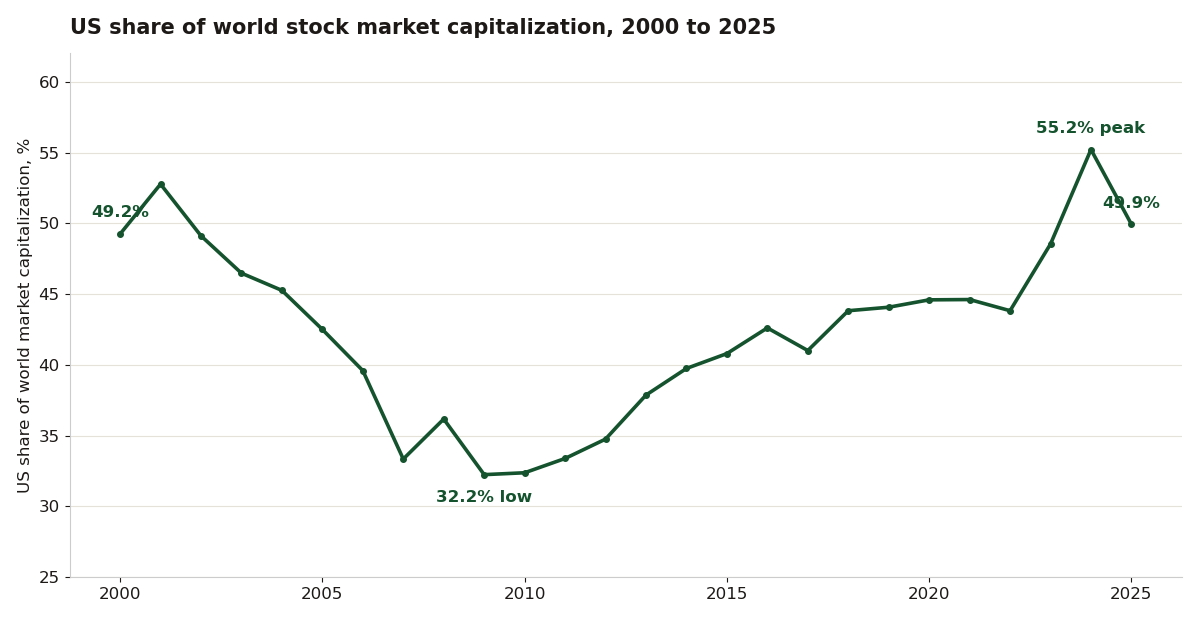
By naming the counter every time. Our charts run on the World Bank series and say so; when we quote a live census or a federation figure, the source travels with the number, as it does in every article in this series. A ranking without a named counter is a number looking for trust it has not earned. When two rankings disagree, do not average them. Ask what each one counted, and the disagreement usually resolves into a definition you can choose on purpose.